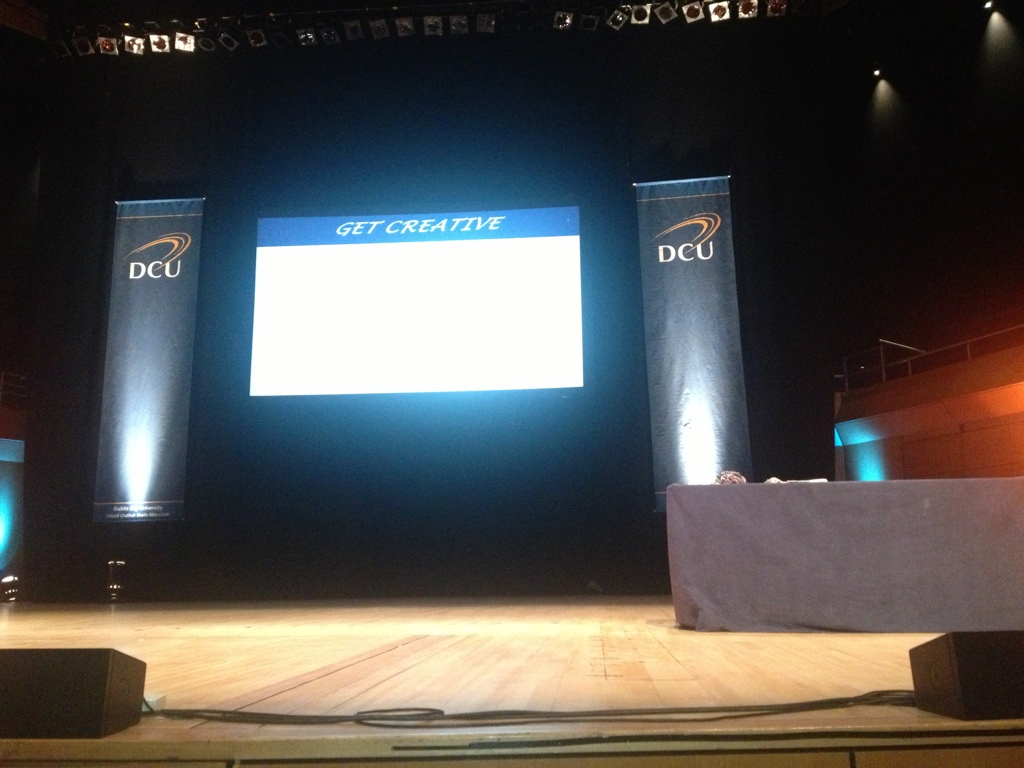
Presentation Techniques: 6 Secrets To Giving Amazing Presentations

Presentations can be unbearable.
We average 5.6 hours each week in meetings and 69 percent of us feel they aren’t productive.
Which presentation techniques can help you improve your delivery and convince your audience?

1) To Inspire, Start With “Why” not “What”
What magic do both the speeches of Martin Luther King and the marketing of Apple have that move us to believe and act?
Simon Sinek, author of Start with Why: How Great Leaders Inspire Everyone to Take Action, has an interesting theory:
People don’t buy what you do. They buy why you do it… Start with “Why.”
Start with the goal, the messianic mission, and get them on board emotionally. Then when you describe the solution, they’re already sold.

2) Begin With What You Know They Believe
If you start a presentation telling iPhone users how great Android phones are, you’ve already lost them emotionally.
One of the presentation techniques you should always employ is to meet your audience on common ground early in, show them you’re one of them, then guide them where you need them to go.
Via 100 Things Every Presenter Needs to Know About People:
If you start your presentation with the opposite of what they believe, they may turn you off right away… But if you start with an idea I agree with or know about…then you have a chance of getting through to me.

3) Tell Stories, Not Stats
Maybe you’re not the best presenter so figure you’ll convince your audience with tons of evidence.
Bad move. Yes, being a polished speaker helps but research from Stanford shows polish isn’t memorable. Neither are statistics. What is?
Stories.
Via Made to Stick: Why Some Ideas Survive and Others Die:
When students are asked to recall the speeches, 63 percent remember the stories. Only 5 percent remember any individual statistic.
Furthermore, almost no correlation emerges between “speaking talent” and the ability to make ideas stick…The stars of stickiness are the students who made their case by telling stories, or by tapping into emotion, or by stressing a single point rather than ten.

4) PowerPoint Makes You Stupid
One of the worst presentation techniques is relying on PowerPoint like a crutch.
Numbers projected on the wall don’t convince, emotions do.
People need to connect with you, not the screen.
Via How PowerPoint Makes You Stupid: The Faulty Causality, Sloppy Logic, Decontextualized Data, and Seductive Showmanship That Have Taken Over Our Thinking:
“PowerPoint makes us stupid.” This is what Marine General James N. Mattis declared at a military conference (in a speech given without PowerPoint) in North Carolina in April 2010. The article in the New York Times reporting the remark revealed the pervasive role the software was playing in the American armed forces. It reached the point that the then head of American and NATO forces in Afghanistan, General Stanley A. McChrystal, accused PowerPoint of having become the U.S. Army’s principal enemy, nothing less.

5) Use Imagery When You Speak
Research shows that using imagery makes you more charismatic. Use metaphor, visualize and make things concrete.
Speakers are seen as more charismatic when otherwise identical speeches contain more imagery:
A former US president’s inaugural address was rewritten to create low and high imagery versions, and audio recordings of the two speeches were made. Participants were randomly assigned to high or low speech imagery conditions. After listening to the speech, they provided ratings on various summary leadership measures. The high imagery speech resulted in higher ratings of charisma than the low imagery speech.

6) To Get Buy-In, Make Your Ideas Their Ideas
Don’t think you need to convince people by beating them down with facts or fighting their objections.
One of the most powerful presentation techniques is taking the attitude of inviting the audience in.
Let them make your ideas their own. This will get them emotionally invested and they’ll support you.
Dan Pink, author of To Sell is Human, explained it when I interviewed him:
Basically, these two scholars, they started studying Hollywood pitching. They did a very exhaustive study. Basically what they found, which you know, I’m sure, from your screenwriting days, is that pitching isn’t about convincing somebody, pitching is essentially about inviting them in.
That’s essentially their view. That changed my view on it a little bit. I think pitching is like, “Are you with me?” and actually that’s not the way to do it. The way to do it is, “Here’s the pitch. What’s your contribution?” When the other side contributes, it actually builds something, and it’s usually a little bit better, but also the other side is more invested in it and so forth. The idea of pitching is to begin an engagement with somebody, not to necessarily convince them right there.

History of the Payment System

The history of the payment system itself is dated back to the years of the barter system, which then led to coins and bank notes to debit and credit cards and most recently online payment.

According to Chown (1994, p.2)
“The history of money actually began in about 800 BC when the first coins were struck from electrum, a naturally occurring alloy of silver and gold, bearing the sign of a half lion as a guarantee of their weight. The coins were then supplemented with bank notes, before convenient method of cheque and now electronic method of payment using mobile platform and electronic transfer”
Barter

Bartering can be dated back to 6000BC and according to Chapman (1980, p.35)

“Barter is typically considered as exchange that is to say that no third object (money) part takes in the transaction”.

In simpler terms bartering was the system in which people exchanged the goods that both parties needed without the need for cash or money.

The Coin Age

According to Surowiecki (2012), it was in the seventh century BC, when the small kingdom of Lydia which is now situated in Turkey introduced the world’s first standardized metal coins which led to people recognising it as being valuable and hence using it as money. Soon after it was recognised that a coin was not enough and by end of fourteenth century nearly every country in Europe were using three coinage metals: gold, silver, and copper or nickel, Chown (2004 p.14).

Bank Note
Paper money was first issued in China during the eleventh century by the Song Dynasty; the purpose was to issue it as a receipt of deposit in order to avoid the bulk of copper coinage. In Europe according to Salmony (2011) “Paper money was recognised as legal tender in Germany over 100 years ago and today over 75 percent of retail payments are still made using cash”

Credit/Debit Cards
The phenomenon of using a card as means of payment dates back to 1950 when Frank McNamara, the head of a financial company in New York City came up with the idea to use a “charge card” instead of physical money itself as a means of payment. McNamara named the card “The Diner Club Card” which was originally made from paper and was accepted by a range of different businesses including restaurants, retail stores and travel institutions. The Diners Club Card was hugely popular between 1951 and 1955 and the company monopolised the credit card industry until 1958 (Credit Card 2010). However, during this year other companies emerged, such as American Express who launched the first plastic credit card and BankAmericard also known as Visa who then began to dominate the market.
Internet Payment
In the mid to late 1990’s, organisations in the retail, business to consumer and business to business industries began to embrace the Internet as a new sales channel and in turn provided new possibilities for payment innovation, this subsequently led to the emergence of hundreds of new payment companies which aided the online transaction (Weichert 2007).

The Future of Paypal

Paypal- is an eBay company that enables anyone with an email address to send and receive online payments safely, easily and quickly. (www.screw-paypal.com)
The increase in online shopping and the fear of fraudulent activities; open up a new market for online payment. The company was founded when Confinity and X.com.Confinity merged in March 2000 (www.screw-paypal.com). Their sole strategy was to offer a secure and easier way to pay without exposing your financial details to merchants. Your bank account and credit card can be linked to your paypal account thereby making payment easy. A merchant who owns a paypal account can attract more customers from all part of the world; due to the perceived trust of secure and fast payment process offered by the company.
The future of paypal
In September 2011, paypal unveiled its plan for mobile payment space in order to compete with the Google wallet that was launched earlier May 2011. Tricia Duryee (2011).
According to Tricia Duryee(2011), the main features of the paypal plan is to enable offline payment using a phone number and PIN code to replace swiping a credit card at the payment terminal. The new system will also integrate check-in capabilities to its mobile application and location-based services to identify nearby stores or restaurants. The strategy behind this move is enable digital wallet payment without going about with your debit and credit cards and the location based service will help to increase sales as consumers will be notify if there is sales going on; the digital wallet will enable you to pay without actually having cash with you.
Why the move to offline and mobile technology?
According to Patrick Dupuis Paypal CFO, the move to offline is based on the big data information at the disposal of the company. The company decides to focus more on the customers rather than the merchant. Dupuis when speaking in an interview said that the shifts of focus will be adopted by the consumers because of the ease to recover password “passwords recovery. He says the PayPal engineers seemed to have assumed everyone always knows their password. “But of course not, People forget their password,” he says. PayPal made it a lot easier to recover passwords, prompting a boost in PayPal adoption. “In my two years at PayPal I’ve never seen such a more immediate move in our consumer metrics from something that simple.”( Cfo-insight.com). The company hopes that users will adopt the new technology that has already be rolled out in the US with big company like Abercrombie & Fitch, Advance Auto Parts, Aéropostale, American Eagle Outfitters, Barnes & Noble, Foot Locker, Guitar Center and others. (wepronews.com)

Is social media the way forward for creating brand awareness and marketing in the 21st century? This article attempt to answer this questions

lcowie's avatarLesley Cowie

Social media Web sites like Facebook and Twitter began as networking hubs for friends and family members. Seeing the successes of these online applications, enterprises and small businesses have joined the bandwagon, by building relationships with their customers online and marketing their brands to a new demographic. In this new form of marketing, companies have been challenged to develop a standard for measuring their return on investment. Since Facebook and Twitter allow for free participation, social media marketing has emerged as the quickest and easiest way for companies to market their product or service. Business professionals face a complicated dilemma, in which they must decide if social media marketing is worth the time investment put forth by their public relations practitioners. In order to appreciate social media as an effective marketing tool, public relations professionals must first establish a fundamental objective, coherent campaign and resulting efficiency standard before participating.

Social…

View original post 5,002 more words

Ipad competition

Anybody can be a winner, its how you think! Most times we seems to defeat ourself before a competition or an events begins.

I am usually sceptical about taking part in competition (raffle draw), knowing fully well that the end result will be determined by somebody not by your direct effort.

On this particular day I decided to do the online test and the library tour. My main purpose was to win the iPad that I desperately need to see my beloved family using the facetime technology. Eventually, my phone rang with a deep lovely voice from the other end of the call informing me that I am the lucky iPad winner. I was so elated, knowing that my dream of owning an iPad has been accomplished on a stress free basis.

I have learnt a personal lesson to participate in anything to have a chance to partake of its reward. This is also true in real life scenario, you have to put in your best to have a good chance to turn your life for the better.

Have a look at the presentation of the iPad. on the link below:

http://dculibrary.wordpress.com/2012/11/09/ipad-competition-winner/

Cheers!